


What Size Sectional Do I Need? A Complete Guide to Choosing the Right Sectional Sofa

Choosing the right sectional sofa is about more than finding a style you love. The sectional needs to fit your room, provide enough seating, leave comfortable walking space, and work with the way you actually use your home. A sectional that is too large can make a room feel crowded, while one that is too small may not provide enough seating or visual balance.
So, what size sectional do you need? The answer depends on your room dimensions, layout, seating requirements, sectional configuration, and the amount of open space you want to maintain. Whether you are furnishing a large family room, a modern condo, or a compact New York City apartment, taking the time to measure before you buy can make all the difference.
In this guide, we'll explain how to measure for a sectional, how much space to leave around it, what sectional dimensions to consider, and how to choose between different sectional configurations.
What Is the Right Size Sectional for My Room?
There is no single sectional size that works for every living room. A sectional's ideal dimensions depend on the size and shape of the room, the location of doors and windows, your existing furniture, and how many people you want to seat.
As a general starting point, sectional sofas are commonly available in a wide range of widths, with compact models designed for smaller spaces and larger configurations intended for spacious living rooms and family rooms.
Canal Furniture's sectional sofa collection includes different configurations and sizes, including L-shaped sectionals, chaise sectionals, curved sectionals, reclining sectionals, sleeper sectionals, and modular designs.
Instead of choosing a sectional based only on its advertised seating capacity, look at its overall width, depth, chaise length, configuration, and footprint.

Common Sectional Sizes
While dimensions vary considerably between manufacturers and designs, thinking in general size categories can help you narrow down your options.
Small Sectionals: Approximately 90–110 Inches Wide
Smaller sectionals can be a practical choice for apartments, condos, studios, dens, and compact living rooms. They provide the advantages of sectional seating without requiring the footprint of a large family-room sectional.
If you are furnishing a smaller space, pay particular attention to both width and depth. A sectional that is relatively narrow but very deep can still consume a significant amount of usable floor space.
Explore Canal Furniture's small space sectionals for compact configurations designed for apartments and smaller living rooms.
Medium Sectionals: Approximately 110–130 Inches Wide
Medium-sized sectionals are versatile enough for many average-size living rooms. They can provide generous seating without necessarily overwhelming the room.
This size range can work particularly well when you want a sectional to serve as the primary seating area while still leaving room for a coffee table, TV stand, accent chair, or side table.
Canal Furniture offers sectionals in a variety of widths, including options in the 120–129 inch range.
Large Sectionals: Approximately 130 Inches and Larger
Large sectionals are well suited to spacious living rooms, open-concept homes, large family rooms, and entertainment spaces where generous seating is a priority.
Larger sectionals can provide plenty of room for family and guests, but they require careful planning. Remember that the sectional's depth and chaise length can be just as important as its overall width.
If you have a large room, consider a large L-shaped sectional, modular sectional, U-shaped configuration, or another design that can take advantage of the available space.
How to Measure Your Room for a Sectional

Before shopping for a sectional, measure the room where you plan to place it. Don't rely on estimates or assume that a sectional will fit simply because the wall appears long enough.
Start by measuring:
- Wall length: Measure the wall or walls where the sectional will be positioned.
- Room width: Measure the distance from the sectional wall to the opposite wall or furniture.
- Ceiling height: This is especially useful when considering a large sectional in a room with other tall furniture.
- Door locations: Note doors that open into the room and the amount of clearance they require.
- Windows: Make sure the sectional does not block windows, radiators, or other important features.
- Walkways: Identify the areas people need to use to move through the room.
- Existing furniture: Measure coffee tables, TV stands, chairs, cabinets, and other pieces that will remain in the room.
Once you have these measurements, mark the approximate dimensions of your desired sectional on the floor using painter's tape. This is one of the easiest ways to visualize how much space a sectional will actually occupy.
How Much Space Should I Leave Around a Sectional?
A sectional should not simply fit inside a room. It should fit comfortably.
Leaving adequate clearance around your furniture helps maintain a natural flow through the room and prevents the sectional from making the space feel cramped.
As a general guideline, aim to maintain approximately 30–36 inches of walking space in major traffic paths whenever possible. You may need more or less depending on the room's layout and how the space is used.
The area between your sectional and coffee table is also important. You want enough room to comfortably sit down, stand up, walk around the table, and access the seating without making the furniture arrangement feel disconnected.

Don't Forget the Sectional's Depth
One of the most common mistakes when shopping for a sectional is focusing only on its width.
Depth matters just as much.
A sectional with a deep seat can be extremely comfortable for lounging, but it can also take up considerably more floor space. In a smaller living room, a shallower sectional may leave more room for walking and other furniture.
When comparing sectionals, look at the complete dimensions rather than simply searching for the narrowest width.
Pay attention to:
- Overall width
- Overall depth
- Seat depth
- Chaise depth
- Chaise length
- Arm width
- Back height
How Big Should a Sectional Be for a Small Living Room?

If you have a small living room, you don't necessarily have to give up the comfort of a sectional. The key is selecting a design with proportions that match the room.
Look for:
- Compact overall dimensions
- Narrower arms
- Moderate seat depth
- Streamlined frames
- Chaise configurations that don't block walkways
- Low-profile modern designs
A sectional can actually be an efficient choice for a small room because it combines multiple seating positions into one piece of furniture.
Instead of purchasing a full-size sofa, loveseat, and separate lounge chair, a compact sectional may provide the seating you need while making better use of a corner or wall.
Browse Canal Furniture's small space sectional collection for apartment-friendly options.
Choosing Between an L-Shaped Sectional and a Sofa With Chaise

The configuration of your sectional can have just as much impact on your room as its dimensions.
L-Shaped Sectionals
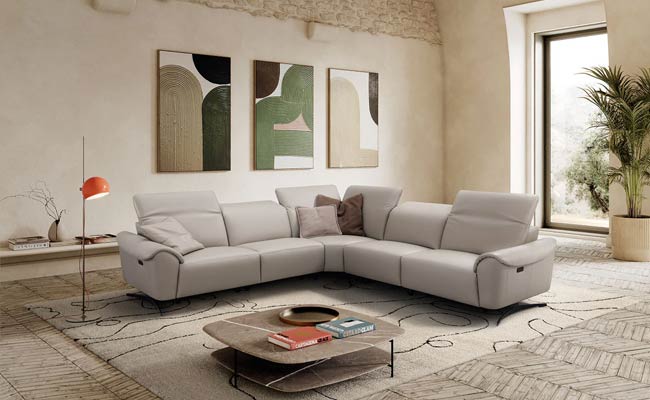
An L-shaped sectional can be an excellent option when you want to make efficient use of a corner. The two sides create a natural seating area while helping define the living room.
L-shaped designs work particularly well in rooms where one side of the sectional can sit against a wall.
Sectionals With Chaise
A chaise sectional combines a sofa with an extended chaise lounge. It provides a comfortable place to stretch out without requiring a separate lounge chair or ottoman.
Chaise sectionals can work well in both large and small rooms, but you need to carefully consider the length and position of the chaise. Make sure it does not interfere with a doorway, walkway, or other furniture.
Which Way Should the Chaise Face?
Before ordering a sectional with a chaise, determine whether you need a left-facing or right-facing configuration.
Look at the entire room rather than simply choosing the side that looks best in a product photograph.
Consider:
- Where your television is located
- Where doors open
- Where windows are located
- Where the primary walkway is located
- Where other furniture will be placed
- Which direction you want the chaise to extend

How Many People Should Your Sectional Seat?
Think about how you actually use your living room.
If the sectional is primarily for one or two people, buying the largest sectional that fits your room may not be necessary. If you regularly entertain family and friends, additional seating may be more important.
- 1–2 people: A compact sectional may provide plenty of seating and lounging space.
- 3–4 people: A medium-sized sectional can provide comfortable everyday seating.
- 5+ people: Consider a larger sectional or a sectional combined with an accent chair or additional seating.
How Big Should a Sectional Be for a Family Room?
Family rooms often benefit from larger sectionals because they are frequently used for watching television, relaxing, entertaining, and spending time together.
If you have the available space, a larger L-shaped, modular, reclining, or chaise sectional can create a comfortable central seating area.
Larger rooms may also benefit from a modular or larger sectional that can accommodate multiple people while becoming the focal point of the room.
What Size Sectional Works Best in an Apartment?

Apartment living requires additional planning because you have to consider both the room and the building itself.
A sectional may fit perfectly inside your living room but still be impossible to bring through the building's entrance, hallway, elevator, stairway, or apartment doorway.
Before ordering a sectional for an apartment, measure the complete delivery path.
Measure These Areas Before Ordering:
- Building entrance
- Lobby and hallway width
- Elevator interior and doorway
- Stairway width and turns
- Apartment entry door
- Interior doorways
- Ceiling height and tight corners
- The room where the sectional will be placed
Should My Sectional Be Against a Wall?
Not necessarily.
In many living rooms, placing the sectional against a wall is the most efficient use of space. However, a sectional can also be used to define an open-concept living area.
In a large open room, placing a sectional away from the wall can help establish a dedicated living area while creating separation between the living room and dining or kitchen areas.

How to Use Painter's Tape to Test a Sectional
One of the easiest ways to determine whether a sectional will work in your room is to create a full-size outline on the floor.
- Measure the sectional's overall width.
- Measure its overall depth.
- Measure the chaise length if applicable.
- Use painter's tape to mark those dimensions on your floor.
- Walk around the taped area.
- Open nearby doors and drawers.
- Place your coffee table location within the layout.
- Check the walking paths around the room.
This simple test can reveal problems that aren't obvious from looking at a sectional online.
Don't Forget Your Coffee Table
Your sectional and coffee table should be considered together. A sectional may fit perfectly against the wall but leave insufficient space for the coffee table or make the center of the room difficult to navigate.
Choose a coffee table that is appropriately scaled to the sectional. Rectangular tables often work naturally with L-shaped sectionals, while round or oval tables can help soften the lines of a large sectional and make circulation easier.
Browse Canal Furniture's modern coffee tables to find options that complement your sectional and overall living room layout.

Consider the Height and Visual Weight of Your Sectional
Two sectionals with similar measurements can create very different visual impressions.
A low-profile sectional with slim arms may feel more open and streamlined, while a sectional with wide arms, tall backs, and deep cushions may appear substantially larger.
If your room is compact, consider a sectional with:
- Clean, streamlined lines
- Narrower arms
- A lower profile
- Moderate depth
- Legs that allow some visibility underneath the sofa
What Size Sectional Is Best for You?
The best sectional is not necessarily the largest one that will fit in your room. It is the one that provides the right combination of comfort, seating capacity, dimensions, configuration, and usable floor space.
Before purchasing, ask yourself:
- How much wall and floor space do I have?
- How many people need to sit comfortably?
- Do I want a chaise?
- Would an L-shaped configuration work better?
- Which direction should the sectional face?
- How deep can the sectional be?
- Where will the coffee table go?
- Where will the television go?
- How much walking space do I need?
- Will the sectional fit through my delivery path?
Shop Sectional Sofas at Canal Furniture

At Canal Furniture, we offer a wide selection of modern and contemporary sectional sofas in different sizes, configurations, materials, and styles. From compact sectionals for apartments to larger designs for spacious living rooms, you can find options for a variety of room layouts and lifestyles.
Explore our complete sectional sofa collection, or shop by configuration to narrow your search.
- Small Space Sectionals – Compact options for apartments and smaller rooms.
- L-Shaped Sectionals – Efficient corner-friendly configurations.
- Chaise Sectionals – Sectionals designed for comfortable lounging.
- Modern Sectionals – Browse the full selection of sectional sofas.
If you're unsure which size or configuration will work best for your room, take your measurements with you when shopping. Our team can help you compare sectional dimensions and configurations based on your available space.
Frequently Asked Questions About Sectional Sizes
What is a good size sectional for a small living room?
A compact sectional can be an excellent choice for a small living room. Rather than focusing on a specific width, consider the entire footprint, including depth and chaise length. A sectional around the 90–110 inch range may work in some compact rooms, but your room dimensions should determine the final size.
How much space should I leave around a sectional?
Try to maintain approximately 30–36 inches of clearance in primary walking paths when possible. The exact amount depends on the room layout, doors, furniture placement, and how the space is used.
How do I know if a sectional is too big for my room?
A sectional may be too large if it blocks walkways, prevents doors from opening comfortably, leaves little room for a coffee table, crowds other furniture, or makes the room difficult to navigate. Use painter's tape to mark the sectional's actual dimensions on the floor before purchasing.
What is the difference between sectional width and sectional depth?
Width measures how far the sectional extends from side to side, while depth measures how far it extends into the room. Both measurements are important when determining whether a sectional will fit comfortably.
Can I put a sectional in a small apartment?
Yes. Compact sectionals and chaise sectionals can work very well in apartments when appropriately sized. Be sure to measure both your living room and the complete delivery path, including building entrances, elevators, hallways, stairs, and doorways.
Should I choose an L-shaped sectional or a chaise sectional?
An L-shaped sectional can be useful when you want to make efficient use of a corner and maximize seating. A chaise sectional may be preferable when you want a dedicated lounging area. The best configuration depends on your room layout and how you use your living room.
How do I measure for a sectional?
Measure the available wall and floor space, then account for the sectional's overall width, depth, chaise length, and configuration. Also measure your delivery path, including doors, hallways, elevators, and stairs. Comparing all of these measurements before ordering can help prevent fitting and delivery problems.
Ready to Find the Right Sectional?
Take your measurements, consider how you use your living room, and explore Canal Furniture's selection of modern sectional sofas. Whether you're furnishing a compact apartment or a spacious family room, the right sectional can provide comfortable seating while bringing the entire room together.


Leave a comment
This site is protected by hCaptcha and the hCaptcha Privacy Policy and Terms of Service apply.